
Fire-Resistant Deck Design

The real threat: embers, not flames
According to Fire Safe Marin, roughly 90% of homes lost in wildfires are ignited by wind-driven embers, not by direct flame contact. The fire doesn’t need to reach your home. A single ember landing in the right gap can do the job.
This means the goal isn’t to surround your home with an impenetrable barrier. It’s to eliminate the surfaces and gaps where embers can lodge and smolder. That shift in thinking opens up far more design possibilities than most homeowners expect, and it puts your landscape and deck design at the center of the conversation, not on the margins.
How the house itself is changing
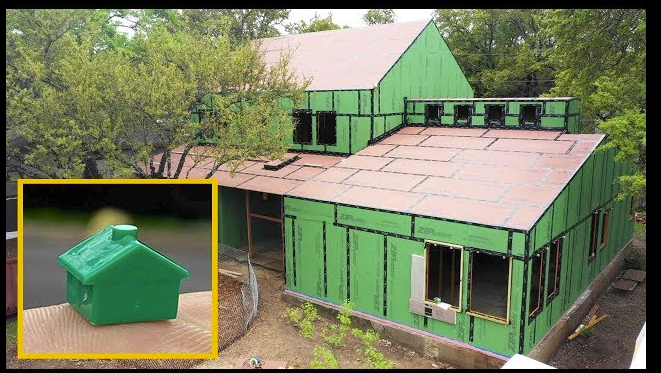
Before we get to your deck, it’s worth understanding how home construction in fire-prone areas is evolving, because your outdoor design and your home’s structure work together.
Traditional attic vents, the small openings under eaves that allow air circulation, are now understood to be one of the most common pathways for embers to enter a home and ignite it from the inside. One response gaining traction is the conditioned attic: a design where the attic is sealed and insulated at the roofline rather than vented to the outside, eliminating those entry points entirely.
Another approach is monopoly framing: construction without eave overhangs, where the roofline drops straight to the wall with no soffit cavity. If you’ve ever looked at the little houses on a Monopoly board, that’s the profile. Simple, clean, and one less place for embers to collect.
Both of these are builder decisions, not garden decisions. But they reflect the same logic that should guide your deck and landscape design: close off every gap, eliminate every ledge, and remove every material that can catch and hold a flame.
Why decks are particularly vulnerable
Decks sit at the intersection of several problems at once. They present a large horizontal surface where embers can accumulate. They typically have a gap underneath the structure where debris collects, creating a sheltered zone where smoldering can go undetected. And they connect directly to the house.
A deck fire is akin to kindling for the main structure. Research from the Insurance Institute for Business and Home Safety (IBHS) has consistently found that attached decks are among the highest-risk features on a home in wildfire-prone areas. Getting the design right, in terms of material choice, how the underside is detailed, and what is planted around it, addresses one of your home’s most significant exposures.
Zone 0: your five-foot design canvas
California’s Zone 0 regulation defines the area within five feet of your home as the most critical zone. All materials within this zone must be non-combustible: gravel, decomposed granite, stone, concrete, or pavers. Potted plants are permitted as long as they are movable.
Rather than treating this as a constraint, Zone 0 is a design element in its own right. A band of river rock, a flush stone terrace, or a well-laid decomposed granite border can form a clean, architectural base that anchors the entire garden. The five-foot zone practically designs itself when you approach it that way.
Zone 0 is now in effect for all new construction in California, and most existing homes have up to three years to comply, though this varies by county. San Diego, for example, has adopted a one-year compliance window for existing structures. Check osfm.fire.ca.gov and your local fire department for the rules that apply to your property.
For homeowners who are not ready to replace an entire deck, addressing the Zone 0 portion alone, the five feet closest to the house, is a meaningful and code-compliant starting point. Some have chosen this path voluntarily; others have been directed to it by their local fire authority. Either way, it opens an interesting design conversation. A non-combustible material that matches the existing decking can create a seamless transition. Or the junction can be treated as a deliberate design moment: a band of stone, porcelain, or decomposed granite that frames the entry to the house and reads as an intentional threshold rather than a retrofit. In some cases, this has led clients to appreciate the contrast enough that the full deck replacement followed naturally in the next project phase.
Deck materials and the real cost over 30 years
Non-combustible and fire-resistant decking materials have improved enormously in the past decade. There is no longer a meaningful trade-off between fire safety and design quality, and as the table below shows, there is often no trade-off on cost either, once you look beyond the initial purchase price.
The lower upfront price of wood is real. What is less visible is the ongoing cost. A well-maintained wood deck in California’s coastal and fire-prone climates typically requires professional refinishing every two to three years, and replacement every 10 to 15 years as moisture, sun, and seasonal movement take their toll. HomeAdvisor and Homewyse place national refinishing costs at $3 to $8.87 per square foot; Bay Area labor rates push that to $8 to $10 per square foot or higher for premium wood species. One of our clients spends approximately $15,000 every three years on professional refinishing alone for her wrap-around decking and elevated entrance at their Woodside, CA home, which speaks to just how quickly maintenance costs compound on larger properties.

*Based on 1,000 sq ft deck at Bay Area installed rates (materials + labor). Refinishing costs based on HomeAdvisor and Homewyse national data ($3–$8.87/sq ft), adjusted to Bay Area rates ($8–$10/sq ft). Labor estimated at prevailing Bay Area rates and will vary by contractor and site conditions. 30-yr total includes install, ongoing maintenance, and full replacement for wood at years 15 and 30. Fire-resistant alternatives assume no replacement within the 30-year window.
The underside problem: and what to do about it now
Whatever surface material you choose, the gap beneath the deck requires deliberate attention. Embers that land on a deck can fall through the boards and accumulate underneath, where they smolder in a sheltered, low-oxygen environment. By the time visible flames appear, the structural members may already be compromised.
The ideal long-term solution is non-combustible framing — steel joists and posts that simply cannot ignite. But for homeowners who are not yet ready for a full structural rebuild, there is a meaningful set of interim measures worth knowing about:
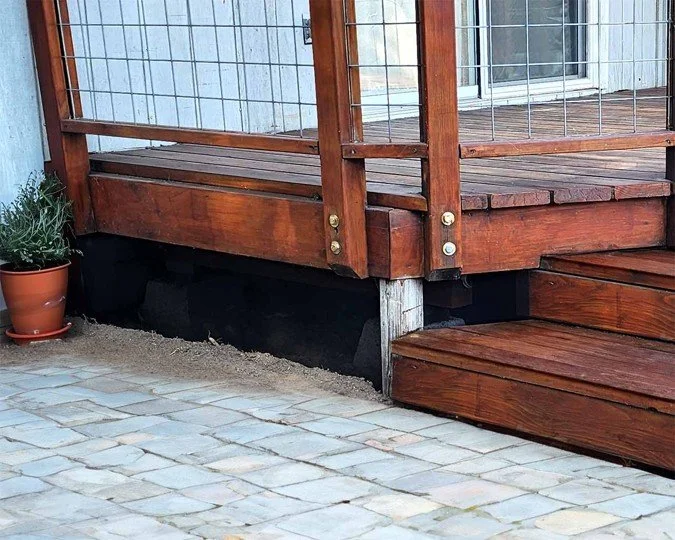
● Ember-resistant mesh skirting. Metal mesh installed around the perimeter of the deck and buried a few inches into the ground to close the gap at grade is one of the most effective and accessible retrofits available. Products such as Wildfire Defense Mesh and EmberMesh are designed specifically for this application and can be installed by a competent homeowner or contractor without structural work.
● Non-combustible horizontal enclosure. Attaching non-combustible sheathing or panel material to the underside of the structural members closes off the space entirely. Fire Safe Marin also recommends adding an 18-inch metal flashing strip between the top of the deck and the home’s exterior siding, tucked behind the siding at the top, to create a barrier at the most critical junction of all.
● Intumescent coatings for existing wood. If replacing the framing is not yet in scope, intumescent coatings applied to joists and structural members provide meaningful protection. These paints expand when exposed to heat, forming an insulating char layer that slows ignition and buys time. Products such as the Firefree Wildfire System and Flamex PF-2 carry Class A ratings and are formulated for exterior wood. They require periodic reapplication and should be applied to clean, prepared surfaces, but they represent a practical bridge for homeowners managing a phased approach to fire hardening.
● Post protection. Deck posts are often overlooked but sit directly in the ember accumulation zone at grade. Non-combustible post bases that lift wood posts off the ground reduce ground contact and debris accumulation. For posts that remain, intumescent coatings applied to the base and lower sections provide the same protection as for joists. Where fencing connects directly to the house, TimberTech is among manufacturers developing non-combustible fencing systems designed specifically for that connection, eliminating one of the most direct combustion pathways from garden to structure.
None of these measures is a substitute for non-combustible materials throughout. But each one reduces the ember pathway meaningfully, and together they can substantially lower the risk profile of an existing deck while a more comprehensive upgrade is planned.
A lesson from Spain: building science is moving fast

BBC article: Enigma of the trees that resist wildfires - 01Sep2015
Fire science moves fast, and local regulations don’t always keep up. For example, Cupressus sempervirens (Mediterranean or Italian cypress) has proven fire-resistance properties and is worth distinguishing from other cypress species such as Arizona cypress and Leyland cypress, which carry genuine fire risk.
Researchers had been documenting its fire-resistance properties since at least 2006 through the EU-funded CypFire project. Then in 2012 a fire swept through nearly 50,000 acres near Andilla in Valencia, Spain, and settled the question dramatically. As the BBC reported, over 98% of the Mediterranean cypress trees in the burn zone were left standing while oaks, pines, and junipers were destroyed around them. The tree’s moisture-retaining needles, widely-spaced crown, and branching structure all limit fire spread. The formal research was published in 2015 and covered widely in mainstream science media.
Around this same period, Fire Safe Marin’s plant guidance was characterizing Italian cypress as a “Roman candle” and recommending its removal. That guidance has some basis for densely planted ornamental hedges, which accumulate dead interior fuel. But it conflates that specific situation with properly spaced C. sempervirens used as a firebreak, on which the published science tells a different story.
The takeaway is that, with the surge of interest in outdoor living, new materials are being introduced every year and new lessons are being learned from both research and real-world fire events. Guidance continues to evolve alongside this growing body of knowledge. The cypress story is one example, but it won’t be the last.
Stay curious, work with professionals who follow the science, and verify current codes in your specific jurisdiction rather than relying on general guidance. osfm.fire.ca.gov is a good starting point, and your local fire department can advise on what applies to your property specifically.
The bottom line
A well-designed deck in a fire-prone landscape is not a compromise between safety and beauty. It is a demonstration that the two are complementary. The gravel surround becomes a design feature. The low-profile structure becomes an architectural statement. And a garden that genuinely protects the home it surrounds carries a meaning that purely decorative work rarely achieves.
If you are considering a deck project and want to understand what fire-resistant design looks like in practice for your property, we would be glad to talk. Every site is different, and the best solutions almost always begin with a site visit.
Always verify current fire codes with your local jurisdiction before finalizing any design. Requirements vary by county and are updated as new research and legislation emerge.
